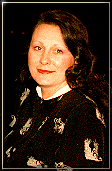
Mary Metcalfe
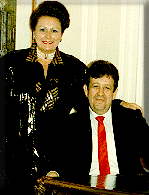
She has
grasped with both hands the wonderful opportunities this country
offered.
Working
closely with her husband, Alan
Metcalfe, she has become a self made, successful Australian.
Their collective
business acumen and hard work led them to open up a number of
business ventures in Australia over their 25 years of marriage,
and has culminated in the establishment of an international
telecomputer communications network that they presently conduct
from a base in California, USA. (Dated 1992)
Mary returns
regularly to Hungary with ideas and skills that she hopes will
assist her former people to emerge from the grip of communism.
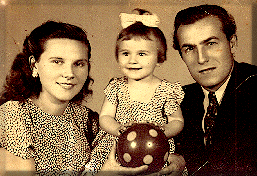
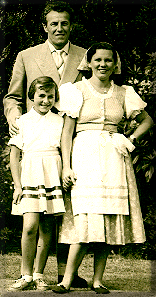
"My Father, Laszlo, served with the Hungarian Air Force on the German side in World War II. He had been captured by the Russians near the Austrian border and was fortunate to have escaped whilst being transported to the terrible prisoner-of-war camps in Russia. He walked back
to Budapest, where he began his studies as an electrical engineer
and eventually became a foreman in a large state-owned enterprise
there.
Dad loved
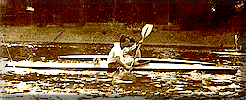
his water sports. He did kayak in summer and played water
polo during winter. On summer
weekends I can vividly remember going up the Danube to kayak
carnivals and the camping grounds. Dad was a top exponent
of kayak.
His twin nephews, George and Steve, who won medals at three Olympic Games and several world championships in kayaks and dad gave great encouragement and support to them. They were selected but unable to compete at the Melbourne Olympics in 1956 because of the revolution in Hungary and the fear they might defect. My Mother was a member of the historic Nagy family. Her parents worked on a collective farm near Mosonmagyarovar, a city in the north-west of the country.
"I don't remember much about the revolution which took place in Hungary in November, 1956. A group of university students were brave enough to rebel against the repression by the communists and took over a radio station. The Russians reacted by sending in the army. We listened to the radio for news of the students. My cousin, who was one of them, was shot five times. I was among the children who lined the streets to see the Russian tanks roll into Budapest. We received gifts of chocolates from Russian soldiers marching besides the tanks. One soldier who spoke Hungarian said they were sorry to be in our country but would have been shot if they had refused. This made me realise that wars are not created by the ordinary people but by the system and its leaders! "In a country where everybody was expected to be a member of the Communist Party my family refused to take the easy way out. Although asked regularly to join the party my Father had never joined, preferring to be bypassed for promotion rather than accept a doctrine he didn't believe in. Dad was a seeker after the truth and found the communist interference with the freedom of the individual repulsive to him. He believed that God gives every man the right to follow his spirit in truth and choose how and where he wishes to live. "Dad always wanted to go to Australia. Having read the 'Sunburnt Country' he saw it as a land of opportunity and sunshine and he had made me love it before I even saw it! Mother and he had wanted to migrate there in 1947 but they couldn't organise the papers. Later the Russians were advertising for men for the Aswan Dam project. Although the pay was good and Mother would have let him go, Dad believed that neither position nor money would take the place of a close family unit. Of course we now know that if we had gone there we would never have come to Australia. The freedom was very appealing to those in communist Hungary. God gives most people the choice of how they live their lives but the communists denied that right! "When the 1956 revolution took place my Father was directed as paymaster to stop paying wages to the workers at his factory. He took a strong objection to this decree and went ahead and gave the men and women their pays even though he didn't collect his own wages. In so doing he became a wanted man by the communist regime and knew then that he had to get his wife and daughter out of Hungary quickly. We nearly left our flight too late because Dad kept hoping the revolution would bring about reforms or international intervention, neither of which eventuated." By the time the little Imre family decided to flee the Russians had closed the border with Austria by building armed camps along the border. It had been snowing quite heavily and the ground was very wet. When Laszlo Imre made up his mind that they had to escape their desperation led them to leave behind their possessions, carrying only a small bag and a blanket. Their Hungarian currency units were of no value in Austria and the anti-communist world. Because of Mary and her mother's previous regular visits their train journey to Mosonmagyarovar was uneventful. "My grandparents' farm was fifty kilometres from the border with Austria and it was known that the Austrian authorities had been providing asylum for the thousands of refugees who'd been escaping Hungary. We had first to clear the railway station to get to the farm. Mother knew that the passport which every citizen carried was stamped for every rail journey on disembarking. She and I had in the past established a pattern of regular visits but my Father's passport did not show that pattern.
"As a
result, when we arrived at Mosonmagyarovar my Mother's passport
and mine were stamped but the Russian guards seized my Father.
Two Russian
soldiers were taking him to be locked up when my Mother showed
great bravery and audacity in grabbing a large bundle of passports
from the officer's hands, finding my Father's and saying there
it is, see for yourself! In the resulting confusion she took
Dad's arm and said 'Come on, let us go!' The three
of us walked away from the scene expecting to be gunned down
from behind. In the distance we could see my grandparents
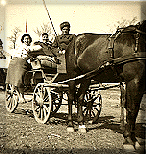
coming to get us in the horse cart. We got in and were driven
away. This was a vivid experience for an eight year old though I was probably too young to experience fear. My parents were very shaken by the experience. "That afternoon we prepared to walk to the Austrian border. Grandfather and Dad had determined that if we walked all night we would reach there before daylight. Grandfather showed us our guiding star to follow and told us not to deviate from that course on any account. We started out with fifteen other Hungarians who were like us seeking to escape. There had been a snow thaw and all night we struggled along through a sea of mud. On a number of occasions during that night we were shot at by the Russians and were forced to dive flat in the mud. We presumed that some of the starting party were shot and some deviated from the star. The Russians fired flare shells which lit up the country so that they could see and shoot us. The most fearsome occasion was when we were travelling through a dead cornfield and we were attacked. The noise we made as we ran and zig zagged would, I feared, be sure to attract their fire, but we got through that and the other occasions when we were forced to deviate around tents occupied by Russian soldiers. "Our little party had dwindled to five people. A Jewish man was unable to keep his shoes on in the mud and slush and we left him at a railway siding to an unknown fate. His daughter, a healthy young girl, demanded that Dad carry her but he said 'No way, if his eight-year old could walk so could she!' We never did find out what happened to those two. As we neared the Austrian border we deviated around numerous tents occupied by Russian troops. Dad kept leading us towards the star and he insisted we both hold on to his hands. After midnight we came upon a tent with what appeared to be soldiers in long woollen underwear walking about. Nearby was a haystack where Dad left us to rest in our blanket. He moved in close enough to hear that the voices were Hungarian. You can imagine our delight when he came back with a huge grin to tell us we were in Austria and free! "These people were refugees like us, warming themselves in front of a fire. What a sight we must have been covered in mud from head to foot! The International Red Cross took us in, bathed us and decked us out in similar long woollen underwear. They fed us and gave us a bed made of hay with a blanket thrown over it. We were put on a train which took us across Europe and through Dover to England. Along the way at every stop there were people who'd heard of our plight and brought along small gifts of fruit and other food. I well remember my first banana given me by a German family and believe it was a good omen for my coming to Queensland. At a village called Winslow near Manchester the Red Cross had taken over a large country house, formerly a girls' school, which was to be our home for the next eighteen months. "I had started school at the infants' school in Pest and initially at Winslow the refugee Hungarian children were all taught together. We were all very keen to learn English so it was welcomed when the authorities decided we should attend the public school in Winslow. Although the first few months were difficult because of the language problem we learned to speak and read English and it was a lot better for US all. My parents did not have the same opportunity for schooling though.
In Hungary
mother had never worked, but she was the first to get a job
in a nearby home where she did domestic duties and made good
friends with the family who employed her. The Red Cross home
had instituted a system where five pounds of pocket money was
handed out each week to the adults and those who had outside
jobs missed out, but Mother
wanted to earn money to send food parcels to her family remaining
in Hungary. She was allowed to receive both because she was
the first to get out and show initiative to work.
When the
time came to leave the Red Cross home the British offered incentives
for us to stay in England. lead was offered a very good job
with a free home and six months food. The Canadians and Americans
offered us migration, but my parents said they wanted to migrate
to Australia. This had been my Father's dream for many years.
That was the star he wanted to follow!
See
Part II - Coming to Australia - click here.
|