|


MARY
& HER MUM.
Part
II - Coming to Australia
"A fter
our escape from Hungary we travelled to England on the same train
as Shari Molnar who, with her four daughters, had also escaped the
revolution and we became our good friends. Shari was the same age
as my parents and Edith was my age. Joe Molnar had migrated to Tasmania,
but his family had been prevented by the authorities from following
him until their escape in 1956. As next of kin, Shari and her daughters
joined their husband and father in Tasmania whilst we were still
at Winslow. The Molnars knew Dad wanted to go to Australia and they
attended to the migration procedures for us to join them in Tasmania.
I will never forget Shari's love and generosity and she remains
a great friend to this day.

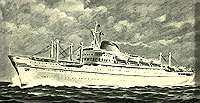
Lloyd
Triestino
|
"We
sailed to Melbourne on the Lloyd Triestino and l enjoyed my
tenth birthday on board ship. At this time of arriving in a
new country I decided that, with my Mother's name being Maria,
I would be known as Mary, the English version, and have been
known as Mary ever since.
Mr Molnar
sponsored our small family to Tasmania and we were allowed
thus to travel direct to Launceston. Dad worked very hard
to improve his English and by hard study got a good job in
his old profession with the Hydro-electric Commission. Mum
also worked and within eighteen months they were able to put
down a deposit on a home in Launceston. For us this was what
the Lucky Country myth was all about.
|
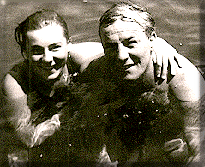
Mary
and her Dad
|
" I attended
the Glenview State School and had the blessing of a wonderful
teacher ".
She insisted
that my English be perfect and spent hours of her own time
tutoring me after school.She
was such a dedicated person and helped me to overcome the
spelling problem which I had.
Because
Hungarian is a language all on its own with no derivatives
it is a very hard language to change from.
Dad, who
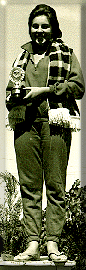
had always loved water sports, taught me to swim and I became
a very good swimmer in Tasmania. Other sports also appealed
to me with the result that I was in the State netball team
at the age of fifteen."
|
|
Laszlo
Imre, who was her coach, had plans to make Mary a champion
swimmer by relocating to the warmer climate of Queensland.
In 196?; the Imres sold their home at Launceston and rented
a home at Brisbane for two years. Mary attended the Kelvin
Grove College where she completed her schooling. Ironically,
she never became a champion swimmer in Queensland, which must
have disappointed her father.
A kindly
taxi driver had taken the family on their arrival to a house
that he knew was available for rent at Highgate Hill. Next-door
staying with his sister was a seventeen-year-old lad who was
working in a butcher's shop by day and studying meat and stock
inspection at night. As Mary got to know Alan Metcalfe she
found him to be a kindred spirit who felt as she did about
life.
Laszlo
had been such a tremendous influence on Mary's thinking and
philosophy that it was no small achievement for Alan to earn
her confidence and affection. He was a free thinker like her
father and they became great friends.
Laszlo
didn't find a suitable job in Brisbane. When he heard of the
wages paid to skilled workers at Mount
Isa Mine he went up and established himself there before
bringing Maria and Mary up to a rented home. Mary didn't like
the idea at all as she didn't want to leave Alan behind.
She was
depressed by the train journey through Townsville and felt
they were going to the end of the world. Nine months later
Mary's father invited Alan to have a holiday in Mount Isa
with them. While he was there Alan was offered a job in a
local butchery and relocated his work and study to there.
At Christmas 1964 Mary and he were engaged in spite of Laszlo's
opposition. He objected because Mary was only sixteen and
Alan eighteen. Laszlo told Alan he could take his ring and
get going! Mary had to have a deep and loving talk to him
before calmer thoughts prevailed.
"Dad
and Alan became great friends and he told Alan that he could
make more money at the mines. With his help Alan got a job
sweeping the floors in the Electrical Engineering section.
|
Mary
the Swimmer
|
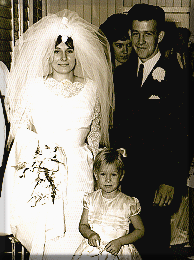
Mary
and Alan's Wedding
|
Because
Alan was quite a good footballer
and well known he soon got a better job working underground
and later a staff position in Underground Planning and Design."
When Mary and Alan were married a year later Laszlo helped
them build their home and swimming pool.
Mary was
seventeen and Alan nineteen. Maria had travelled back to Hungary,
but Laszlo never wanted to look back and was not interested
in returning to his earlier life.
"My Father
was a strong family man, a very spiritual man and true philosopher
who had a tremendous influence on my young life. I have believed
all through my life that God had a special plan for me if
I just let Him walk through with me and just let things happen
without interfering.
Because
of my Father's influence I have felt I was a person of the
world and never been afraid of the dark!
Alan and
I have the same spirit with no limitations and a spiritual
relationship.
|
|
"In 1967,
after our son Clayton was born, Alan was asked to join AMP
as a representative in Mount Isa. He left the Mine and was
successful in reaching top sales figures in Australia for
three consecutive years. Mount
Isa was real pioneering country that brought out the best
in Alan. But it is a hard life for women.
The business
success was tempered with sadness at the loss of two babies
soon after birth. This sadness had a profound effect on our
lives. I know it brought Alan back to earth and the realisation
that no matter how much money you have it cannot take the
place of the lives of your loved ones.
During
this time Alan resigned from the AMP and literally went
bush. The demands of business got too much for him and
I think he needed the solitude of the outback after losing
two children.
Alan
had learnt a lot at Mount Isa Mines and his father had been
a prospector in North Queensland
years before. Alan soon discovered the vast potential of the
Mount Isa and Cloncurry mineral fields, and he established
a good living producing copper
ore for use as flux for the Mount Isa smelters. In 1970
Alan first saw the Hampden Mine at Kuridala south of Cloncurry,
and from his experience at Mount Isa recognised its untapped
potential."
|

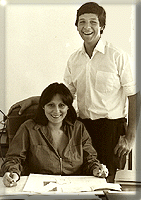
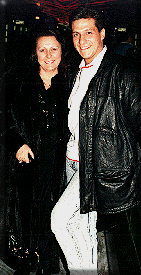
Mary
and Clayton (1982)
|

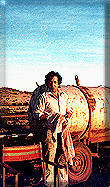
Alan
at Kuridala
|
After
the Metcalfes negotiated an agreement with the owner, they
worked for five years against difficult world copper prices
and negative government to develop the mine's potential. By
1972, when the Whitlam Government was elected, they had thirty
people employed.
They had
planned for a school and hoped to be viable in a year. Then
the new government pegged the price of copper and changed
the tax laws, virtually overnight wiping out Alan and Mary
and many small miners.
"We had
thousands of dollars of bills and commitments at the time
and things looked very bleak for us. I didn't know where we'd
turn to. But Alan dreamt up the idea of and started a free
weekly newspaper in Mount Isa and together we worked the mine
for two years.
I learned
to drive the bulldozers and trucks and how to prepare the
explosives for the mine.
It
was a tough time and I prayed that we'd be delivered out of
that predicament. In time we were able to clear our debts
and think about a new direction in our lives. God has been
very good to us and it wasn't long before our faith got us
out of there and back on our feet again.
|

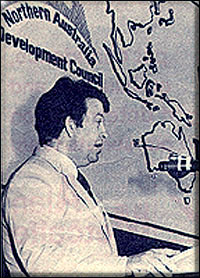
Alan
Chairing NAFC
|
"Alan
got involved in politics because he was frustrated by
the way outback people were being treated by governments in
Canberra and he wanted to do something about it. I don't think
he realised how difficult that would be.
After
he joined the then Country Party he held leadership positions
from the branch to Zone Vice-President.
He worked
with top party officials to form the North Australian Development
Council and was elected its inaugural Chairman for four years.
We made
many friends in the party. Alan was convinced that a fairer
tax system was essential to give people in the outback equality
of opportunity.
Although
we travelled far and wide across Northern Australia we were
unable to raise the support needed to hasten change.
In the
1974 election the National Party asked Alan to go to Tasmania
for two months to organise their campaign there."
In 1978
Mary and Alan moved to Townsville to live because there appeared
to be work to do there in the Party organisation. Alan was
continuing to he troubled by the neglect of the people of
the north by various governments. Although he was warned that
this was a difficult political area and the Nationals had
very little support he became very involved in the Party organisation
as Zone Vice-President, a member of State Management.
|

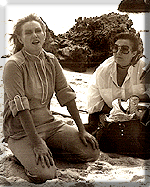
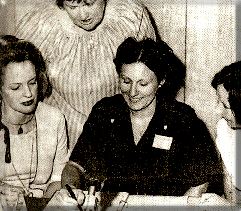
Mary
and Dianne Cilento
|
"The
Townsville newspapers never gave Alan a fair go. I think the
socialists were afraid of what he might accomplish in government.
To communicate our point of view to the northern public and
also to earn a living we started our own newspaper. Alan suggested
the women of the north needed their own paper and I found
myself the proud publisher of 'Townsville
Woman'! Later we went on to produce 14 films for international
television release.
Alan
and I and our team took the National Party support in Townsville
from seven to thirty per cent of the vote in two years.
Twice
Alan sought the Party's endorsement for the Senate and once
he was narrowly beaten in the election for the seat of Townsville
South.
To help
Alan I became actively involved in the NP Women's Section
and was, elected as Zone Vice-President for North Queensland.
It was an interesting experience though I found the infighting
a soul-destroying experience."
|
In 1983 Mary
and Alan moved to Brisbane to the more promising business and political
opportunities offering there. Alan was endorsed as number four on
the NP Senate ticket. The decision to move was somewhat provoked
by the Federal Labor Government's undermining of the Metcalfes'
business move into film production in the north.
Their son, Clayton,
was attending Nudgee College nearby. Mary and Alan sadly conceded
that Australians, especially those in the north did not understand
the threat of socialism as Mary had grown up to understand it, and
that they did not have the time or financial support to further
attempt to change this perception.

Alan and Dr. Doelle
|
"When
we resigned our Party positions late that year we were flat
broke and decided to return to full-time business. We were
offered the worldwide rights to the ethanol technology
developed at Queensland University by Dr Horst Doelle
and, after extensive promotion, were instrumental in forming
Queensland Science and Technology Limited.
The shares
rose to over five dollars under Alan's management before the
crash in 1987, when we lost millions on our seven per cent
of the shares. By 1988, even though Alan had worked selflessly
for five years to get the Company established, we were again
financially devastated."
|
|
In
1984 Mary received the honour
of representing the Women of Queensland at the tenth anniversary
of the "Woman of the Year" luncheon in Canberra. Alan and
her parents were very proud of her.
Mary and
Alan were invited to join the Australian Government Trade
Delegation to Hungary in 1985.
The little
girl who had escaped through the mud in 1956 was given a warm
welcome back, and her relatives were particularly impressed
that she was part of an official delegation. Mary and Alan
could see that the people in Hungary were ready for a change.
They
were sick of communism
and desperately wanted to be freed from its grip. Everywhere
the Metcalfes travelled the people were hungry for information
about how they did business in Australia.
"In 1985
my Father died from a massive heart attack after he'd been
swimming on Sydney's Manly Beach. I was devastated.
There
were so many things that I should have discussed with him
but for which I had never found the time, and I sensed that
there were things he'd wanted to tell me. Time just ran out!
We all loved him so much and respected his great courage and
simple commitments.
|

Mary's
Woman of the Year Team
|

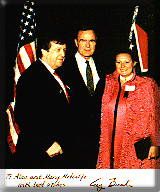
Meeting
President Bush
|
Mary's
and Alan's work with presidential staff preparing the US
Clean Air Act led to a meeting with President Bush in
1986 and an invitation to his inaugeration in 1988.
Alan's
work on selling the QSTL overseas opened the door to many
similar meetings, especially in the United States where the
technology was the most advanced available anywhere.
In 1988
Alan resigned from QSTL and a week later he received a call
from a friend in the US who invited him to advise on a $1
billion coal gasification project in Illinois.
It was
a refreshing change for them as they lived in a luxury apartment
in Chicago for eighteen months. As Mary says, "God has been
kind to us."
|
|
Mary and
Alan's life took another turn at that time when Alan began
writing his second book which expresses all that he tried
to say in politics. Mary does the research for his books,
and they now spend a major portion of their time in the USA.
Their
son, Clayton has joined the family company. With the help
of friends around the world Alan and Mary have formed an international
company called Harp International Business Exchange to market
commmunications technology, especially between the United
States, Australia, Europe and Russia.
"We have
lived a wonderful life, learned and seen so much. I hope Alan's
new book and the Harp Exchange will help many people and bring
about better relations between nations.
As usual
I will be at Alan's side speaking out when I have to and helping
to make our contribution wherever we can. I will always be
grateful to my Dad and Mum
for bringing me to Australia as it has provided us with wonderful
life and many opportunities.
"Through
the years I have never wanted any career but to support my
family and I never wanted the spotlight. This has proved good
for me as it has taken us all over the world and brought us
into the company of many wonderful people.
We have
just gone where the spirit took us and never have we been
daunted by hard times or criticism. In all this I have discovered
that freedom is all about having your say and making your
contribution. It is not something that anyone else can give
you.
|

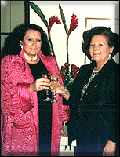
Mary
and Clayton (1990)
|
| FOOTNOTE:
Today Mary and Alan live in Brisbane, Australia where they are
developing Alpha Info Business Servers, which is a development
of the international communications network they began building
in 1990. Mary is the director responsible for Customer Relations
and Sales for HarpBBT and Alpha Info. |
|